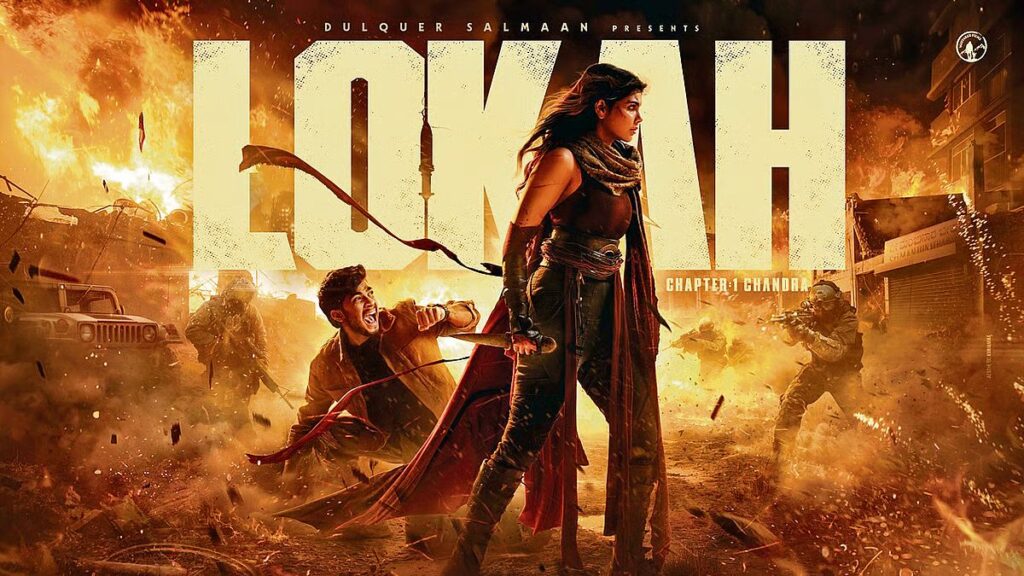

Lokah Chapter 1 arrived in theatres during the Onam season with a bold promise: a locally-rooted, genre-bending fantasy that could rival pan-Indian spectacles. Early marketing leaned into two things that sell tickets fast female lead in Kalyani’s Chandra and production values are bigger. That combination created a high-curiosity opening weekend and social buzz that kept growing through week two and beyond. source file
Box-office trajectory of Lokah that broke expectations
What began as a strong regional opening snowballed into a national run. The film crossed ₹100 crore worldwide within its first week and continued to scale, reaching industry-record figures for a Malayalam release in India. By the fourth week the film had surged past the previous record holder and officially became the highest-grossing Malayalam film domestically — a milestone widely reported across national outlets.
Who’s who: cast, characters and memorable cameos

The casting anchored the film’s magnetism.
- Kalyani Priyadarshan — Chandra (lead): A physically demanding, layered role that the actress prepared for with martial arts training and intensive workshops. Her portrayal is the emotional and mythic center of the film.
- Naslen: Plays the pivotal opposite/supporting character whose relationship with Chandra anchors the human stakes.
- Tovino Thomas, Dulquer Salmaan (cameo as Charlie), Sunny Wayne, Anna Ben, Soubin Shahir and many more: Strategic cameos from well-known stars amplified the movie’s cross-audience appeal, turning curiosity into ticket buys across states.
(For on-page SEO, use H3 subheadings for each key actor and a short one-line description of their character — Google rewards clarity and keyword placement.)
The crew: the invisible engine of Lokah
A film this ambitious depends on a top-tier technical crew:
- Director / Screenplay: Dominic Arun — the architect of the Lokah universe.
- Producer: Dulquer Salmaan (Wayfarer Films) — his production backing and star-power helped secure distribution muscle and media attention.
- Cinematography: Nimish Ravi — crisp, kinetic frames that sell the film’s mythic scale.
- Music: Jakes Bejoy — a soundtrack that blends folk motifs with modern electronic textures, crucial for repeat viewings.
- Editing: Chaman Chakko — paced the film so its visual set-pieces land without exhausting the audience.
Highlight these names with natural anchor text (e.g., “Jakes Bejoy’s soundtrack”) for internal linking to crew profiles or music reviews.

Why audiences connected — four key reasons
- A lead who felt new: Kalyani’s Chandra offered a female lead with action credibility and emotional range — an under-served combination in mainstream Indian cinema.
- Smart world-building: The film fused folk mythology with modern settings, offering viewers a fresh spectacle that still felt culturally rooted. Critics consistently praised the film’s imagination and world-building.
- Word-of-mouth + star cameos: The cameos weren’t just fan service; they functioned as narrative reveals and hooks, encouraging repeat viewing and cross-region interest.
- Soundtrack & visuals that demand the big screen: The music and Nimish Ravi’s cinematography created sequences that people wanted to see in theatres rather than on small screens.
Critical reaction: praise with some caveats
Reviewers lauded the film’s ambition, Kalyani’s performance, and Dominic Arun’s confident stride into a cinematic universe-style storytelling. Many critics noted minor structural imperfections — the occasional tonal wobble that comes with building a large-scale franchise debut — but agreed the film’s strengths outweighed its flaws. Those balanced, positive reviews helped broaden the audience beyond just fandom to more casual filmgoers.
Records & milestones (quick facts)
- Crossed ₹100 crore worldwide within the first week.
- Surpassed the previous domestic Malayalam record to become the highest-grossing Malayalam film in India.
- Continued long-tail performance, with box-office reports showing robust returns into week four and beyond — a rare feat for regional films.
What Lokah means for Mollywood
Lokah’s success is not just a single-title triumph; it signals a structural shift. Bigger budgets handled with local storytelling instincts, female-led tentpoles, and franchise thinking are now credible strategies for Malayalam producers. Expect more studios to chase genre projects grounded in regional folklore, and for pan-Indian marketing plays to become routine for Malayalam tentpoles.
Closing: the sequel question and legacy
With post-credits teases and a director who openly built the film as “Chapter 1,” the sequel question is already being asked. If the makers keep the ingredients that worked — a charismatic lead, tight world-building, and technical bravado — Lokah could become a defining cinematic universe born from Kerala. For now, it stands as proof that Mollywood can create spectacles that travel far beyond its home state.